
Colon cancer
Get answers.
Get screened.
Stay healthy.
What is colon cancer?
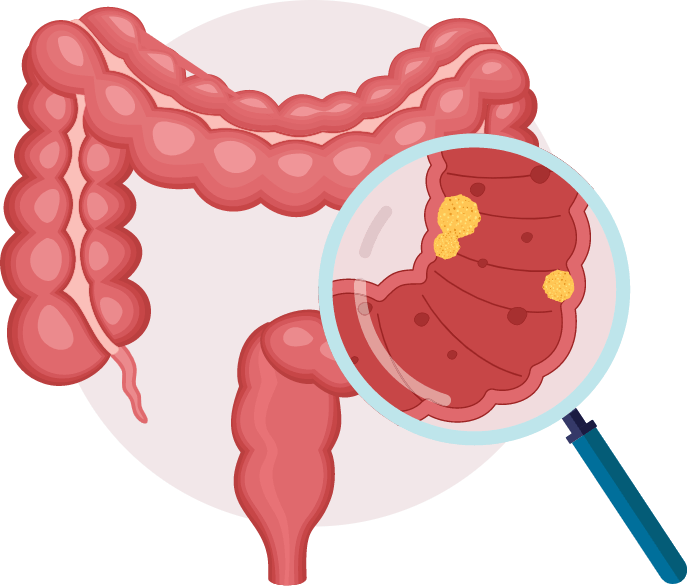
Colon cancer starts as a small precancerous growth in the lining of the colon or rectum.
Colon cancer may develop at any time, but it is more common in adults over 45 years of age.1 Regular screening is important for making sure colon cancer is caught as early as possible.
2nd
Colon cancer has the 2nd highest death rate among cancers2
150,000
More than 150,000 people will be diagnosed with colon cancer this year2
50,000
More than 50,000 people will lose their lives to colon cancer this year2
90% of all colon cancer deaths are preventable if caught early.3
Who should get screened?
Regular screening should begin at age 45.*
If you are generally healthy and have no family history of colon cancer, regular screening is crucial for early detection.
Several health organizations, including the US Preventive Services Task Force, the American College of Gastroenterology, and the US Multi-Society Task Force on colorectal cancer, recommend regular colon cancer screening for all average-risk* adults between 45 and 75 years of age.4-6
If you are 45 or older and at average risk*:
It’s time to start screening for colon cancer
You have options that can help make screening easy and affordable

What are your screening options?
Not all tests are created equal. The US Preventive Services Task Force, the American College of Gastroenterology, and the US Multi-Society Task Force on colorectal cancer all recently updated their guidelines for colon cancer screening to recommend fecal immunochemical testing (FIT) every year or colonoscopy every 10 years as primary screening strategies.4-6
Cologuard® was also evaluated but was not endorsed as a primary screening strategy in these recommendations.
At home
By a gastroenterologist (GI) in a clinic or hospital
Every year
Every 10 years
Small collection wand
May require collecting a sample and biopsy
None
1-2 days of fasting and a large amount of laxatives
At home, in a clinic, or hospital
Every 3 years8
Entire bowel movement
None
Is colon cancer screening covered by insurance?
In many cases, colon cancer screening is covered at low or no cost. However, coverage varies by insurance carrier. Some plans may require patients to pay out of pocket for these tests, so talk to your provider or health plan to determine what your costs may be.
Getting OC-Auto FIT is easy.
If you are between the ages of 45 and 75 and of average risk*, be sure to ask your healthcare provider about annual screening with OC-Auto FIT, or order a kit for yourself today.
Cologuard is a registered trademark of Exact Sciences Corporation in the U.S. and other countries.
*Professional guidelines recommend regular colon cancer screening for all average-risk adults between 45-75 years of age.4-6 For screening purposes, you are at average risk of colorectal cancer if you do not have a personal history of colorectal cancer or certain types of polyps; a family history of colorectal cancer; a confirmed or suspected hereditary colorectal cancer syndrome, such as familial adenomatous polyposis (FAP) or Lynch syndrome (hereditary nonpolyposis colon cancer or HNPCC); a personal history of inflammatory bowel disease (ulcerative colitis or Crohn’s disease); or a personal history of abdominal or pelvic radiation for a previous cancer. Talk to your healthcare provider if you are not sure if you are at average or increased risk of colorectal cancer.8
OC-Auto Sensor io iFOB Test is designed to be used together as an immunoassay test system. The test system is intended for the qualitative detection of fecal occult blood in feces by professional laboratories. The automated test is used for the measurement of fecal occult blood and is useful as an aid to detect blood in stool when lower gastrointestinal bleeding may be suspected.
References:
- Colorectal cancer risk factors. Accessed February 7, 2024. https://www.cancer.org/cancer/types/colon-rectal-cancer/causes-risks-prevention/risk-factors.html
- Colorectal cancer facts & figures 2023-2025. American Cancer Society. Accessed January 25, 2023. https://www.cancer.org/content/dam/cancer-org/research/cancer-facts-and-statistics/colorectal-cancer-facts-and-figures/colorectal-cancer-facts-and-figures-2023.pdf
- Tepus M, Yau TO. Non-invasive colorectal cancer screening: an overview. Gastrointest Tumors. 2020;7(3):62-73. doi:10.1159/000507701
- US Preventive Services Task Force, Davidson KW, Barry MJ, et al. Screening for colorectal cancer: US Preventive Services Task Force recommendation statement. JAMA. 2021;325(19):1965-1977. doi:10.1001/jama.2021.6238
- Shaukat A, Kahi CJ, Burke CA, et al. ACG clinical guidelines: colorectal cancer screening 2021. Am J Gastroenterol. 2021;116(3):458-479. doi:10.14309/ajg.0000000000001122
- Rex DK, Boland CR, Dominitz JA, et al. Colorectal cancer screening: recommendations for physicians and patients from the U.S. Multi-Society Task Force on colorectal cancer. Am J Gastroenterol. 2017;112(7):1016-1030. doi:10.1038/ajg.2017.174
- What is Cologuard®? Cologuard. Accessed February 7, 2024. https://www.cologuard.com/what-is-cologuard
Wolf AMD, Fontham ETH, Church TR, et al. Colorectal cancer screening for average-risk adults: 2018 guidelines update from the American Cancer Society. CA Cancer J Clin. 2018;68(4):250-281. doi:10.3322/caac.21457